Humpback Whale Season in Rio: A Rare Encounter with Nature
June 20, 2026
Pontis Tour
7 min read
There are moments when the sea reminds us that we are guests. When a 30-ton cetacean rises a few meters from the boat, exhales deeply, and dives back into the depths, time stops. Humpback whale season in Rio de Janeiro is a rare — and increasingly precious — window into one of the planet's greatest migrations. Here we share how to enjoy that privilege with respect, science, and the care these giants deserve.
1. The Great Journey of the Humpbacks
Humpback whales (Megaptera novaeangliae) undertake one of the most impressive migrations in the animal kingdom: over 8,000 km between Antarctica, where they feed during the southern summer, and the warm waters of the Brazilian coast, where they breed and give birth between July and November. For decades, the species was on the brink of extinction due to commercial whaling. The South Atlantic population fell to fewer than 500 individuals in the late 1950s. Thanks to the international moratorium and decades of conservation work, today's estimates exceed 25,000 humpback whales returning to the Brazilian coast each winter — one of the ocean's most celebrated recovery stories. Rio de Janeiro, while not the main breeding ground (that title belongs to the Abrolhos Bank, in Bahia), sits on the migration route. In recent years, sightings near our coast have grown — a sign that the population continues to recover and expand its territory.
2. When and Where to Spot Them
The season runs from July to November, peaking between August and October. During these months, mothers and calves travel the coast at a slower pace, while males display spectacular behaviors — full breaches above the water, tail and fin slaps, and the famous underwater songs that can last for hours. In Rio, the best chances of sighting come on open-water tours, generally a few nautical miles offshore. Unlike places where sightings are guaranteed, in Rio an encounter is exactly what it should be: a surprise. There is no promise — and that is precisely what makes the moment unforgettable. An honest tip: never book a tour that promises guaranteed whale sightings. Such promises usually come with practices that pressure the animals — chasing, excessive approach, noise. Nature does not run on business hours.
3. What Responsible Tourism Means
Watching whales is a privilege. And every privilege carries responsibility. In Brazil, cetacean observation is regulated by IBAMA, with clear rules to protect the animals during the period they are most vulnerable — especially mothers with newborn calves. The key guidelines we follow: • Minimum distance of 100 meters between the boat and any whale — and even greater when calves are present. • Always parallel and slow approach, never from the front or from behind. Whales decide how close they get to us, not the other way around. • Engine at slow speed or off when nearby. Noise is one of the main threats to these animals' acoustic communication. • Time limit on observation — to avoid stress and allow other boats to share the moment without crowding. • Never swim, feed, touch, or attempt to interact. We are not part of their habitat; we are silent visitors. When an operator respects these rules, the result is paradoxically better: relaxed whales display natural behaviors — and the sighting becomes more meaningful, not less.
4. The Privilege of Being Present
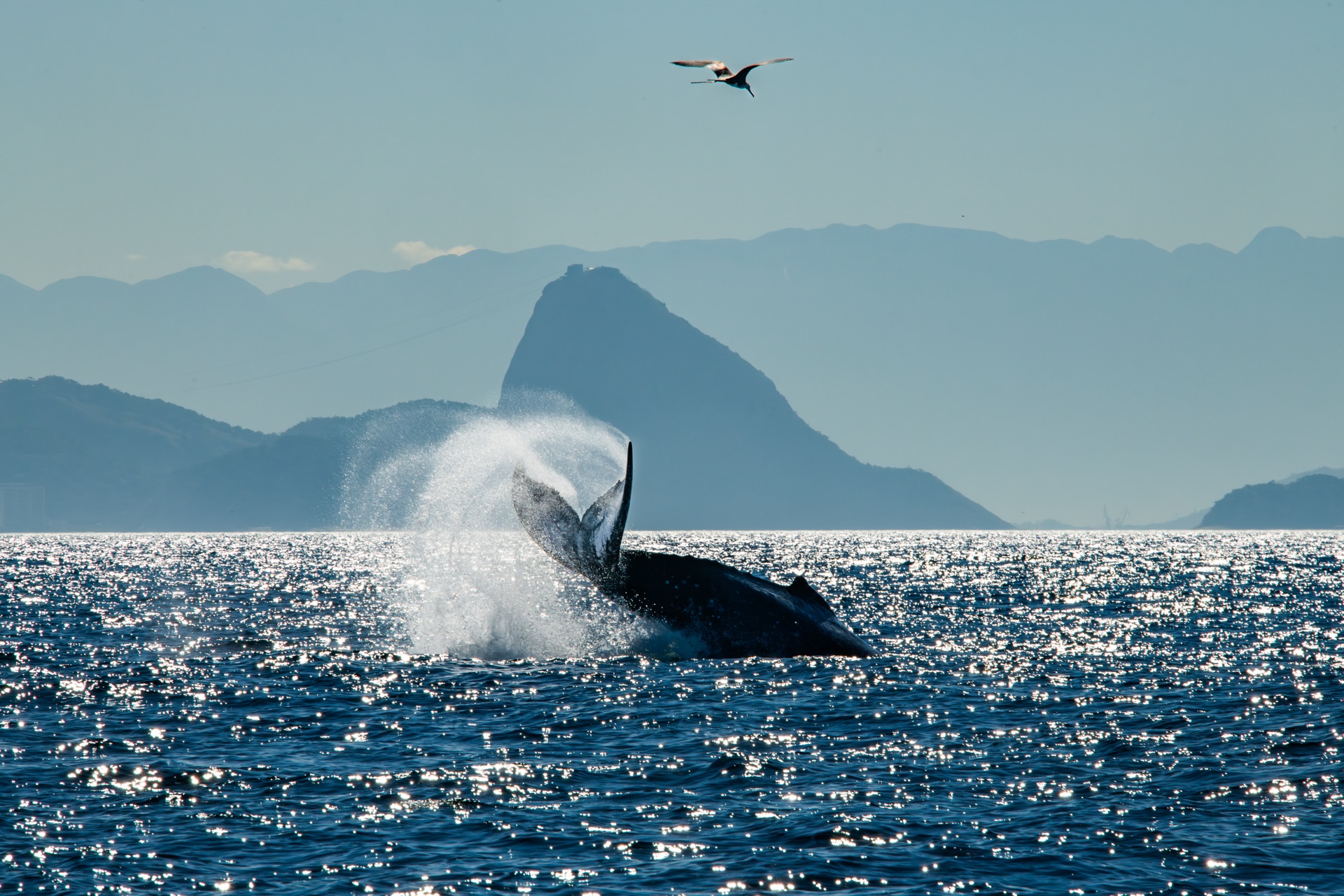
There is something hard to explain when a humpback appears. The sound of the blow, the mist hanging in the air, the tail rising slowly before diving — known as fluking, leaving a perfect water print on the surface. Each tail is unique, like a fingerprint: researchers across the South Atlantic identify individuals by the patterns in that region. Many visitors tell us that a sighting changed something small inside them. It makes sense. We are standing before animals that travel half the ocean, sing songs collectively composed and modified, and maintain mother-calf bonds for years. All of this was happening before us — and it continues, independent of our presence. Pontis Tour believes nautical tourism has an active role in this story. Every passenger who returns moved by a responsible sighting becomes an advocate for marine conservation. The sea needs witnesses — not spectators.
5. How We Operate During the Season
During the season, our open-water tours follow a specific protocol: • When a sighting occurs, we immediately reduce speed and maintain the regulatory distance. Under no circumstances does the boat chase or intercept the animal's natural path. • We communicate sightings to other boats in the area, avoiding situations where multiple vessels surround the same group of whales. • We log date, approximate location, and number of individuals, contributing to research databases when requested. • If sea conditions or the animals' behavior suggest discomfort, we move away without hesitation. That means encounters will sometimes be brief. It also means they will be true — and that we are doing our part to ensure the next season is even richer.
Conclusion
Humpback whale season is a reminder that Rio de Janeiro is far more than beaches and mountains. It is part of a living ocean, connected by ancient routes that are slowly recovering from our own interference. Every responsible sighting is a quiet victory. If you visit Rio between July and November, consider booking an open-water tour. You may see a tail on the horizon. You may only hear a distant blow. You may have a day when the ocean offers only wind and silence. In any case, you will have taken part in something bigger than a tourist outing: the act of being present in a place that belongs to other beings before it belongs to us.