Types of Boats: Which One to Choose for Your Tour in Rio
August 23, 2026
Pontis Tour
8 min read
People who have never chartered a boat tend to assume the choice comes down to size and price. In practice, the type of hull changes everything: the speed, the rocking, the noise, the room to move around, and even the kind of conversation that happens on board. A speedboat, a sailboat, and a catamaran covering the same route on the same day deliver three completely different experiences. This guide breaks down the five most common categories in boat tourism, what each one does best, and how to tell which one suits your group.
1. Speedboat — Speed and Versatility
The speedboat is the most common type in boat tourism, and the reason is simple: it does almost everything well. Its hull is a planing hull — at speed, it rises and glides over the water instead of pushing through it. That means fast transfers and, in practice, more time anchored at the best spots on the route instead of time spent getting to them. Sizes usually range from 25 to 50 feet, with a typical capacity of 8 to 20 people. The standard layout includes a sun deck at the bow, a cabin or canopy for shade, and a stern platform — the step at the back that makes getting in and out of the water easy. Best for: small and mid-sized groups, families, routes that cover more distance, and tours with a swimming stop. Worth knowing: it's the type that feels the sea the most. On windy or choppy days, a speedboat slams against the water more. For many people that's part of the fun, but it bothers anyone prone to seasickness.
2. Sailboat — Silence and Real Sailing
The sailboat is the only category on this list that doesn't need an engine to move. With the sails up and the engine off, the boat leans slightly to one side — what sailors call heeling — and begins moving on wind power alone. What's left is the sound of water running along the hull. Tour sailboats are usually between 30 and 45 feet and carry 6 to 12 people. That's a smaller capacity than a speedboat of the same length, because part of the space is taken up by the mast, the rigging, and the area the crew needs to work. Best for: couples, small groups, contemplative occasions, and photography. An open sail against the landscape is one of the most sought-after images in any coastal destination. Worth knowing: a sailboat is slower and depends on wind conditions. The lean under sail tends to startle anyone who isn't used to it, though it's completely normal and safe. And if the plan involves loud music and people mingling, this isn't the choice.
3. Trawler — A Long Open Deck for Big Groups
The trawler is a fishing vessel adapted for tourism. Precisely because it was built to carry cargo and nets, it offers something leisure boats of the same length can't match: a continuous, flat, wide deck where dozens of people can stand and move around without bumping into each other. Sizes usually fall between 35 and 55 feet, with capacity that easily exceeds 30 or 40 passengers. Most have generous covered areas, a restroom, and real space to set up tables for food and drinks. Best for: events, company gatherings, birthdays with a long guest list, bachelor and bachelorette parties, and groups that want music and service on board. Worth knowing: a trawler is slow and looks more rustic than a speedboat or a yacht. It trades speed and polish for square footage — and for events, that's exactly the right trade.
4. Catamaran — Two Hulls, Almost No Rocking
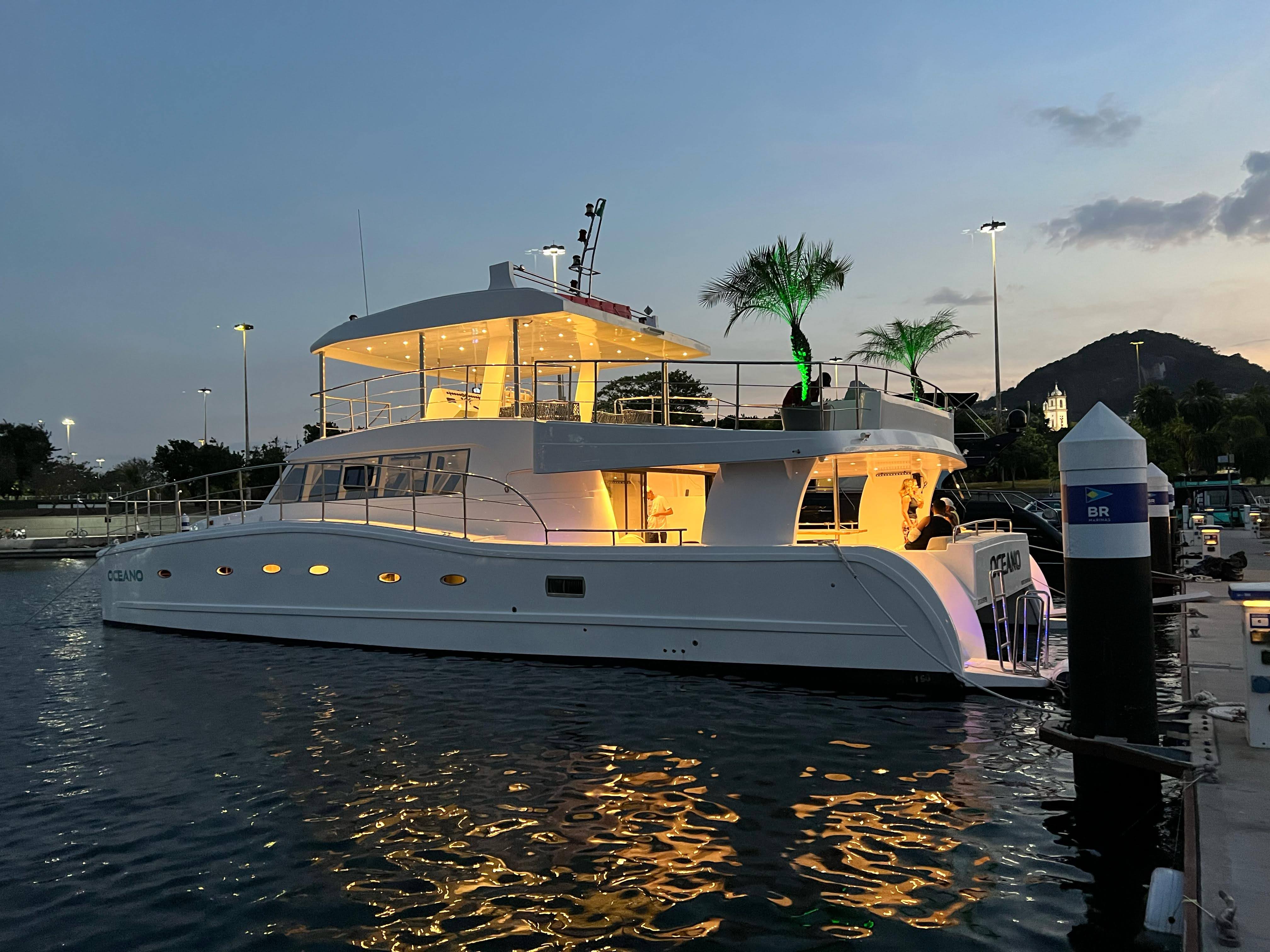
A catamaran has two parallel hulls joined by a platform. That geometry gives it a far wider footprint on the water, and the practical result is what matters most to passengers: it barely rocks from side to side. It's the most stable vessel among tour options. Tour models usually run from 40 to 65 feet and hold 30 to 60 people. Because the upper platform is so wide, many have separate areas — an open deck up top, a covered lounge in the middle, an open stern at the back — letting a large group spread out into different moods at the same time. Best for: larger events, celebrations at sea, groups with small children or elderly guests, and above all, anyone with a history of seasickness. Worth knowing: given its size and structure, it's one of the more expensive categories. Its width also demands more room to maneuver and dock, which limits marina options in some destinations.
5. Yacht — Comfort and Interior Space
Yacht is the term used for larger motor vessels focused on comfort and accommodation. The difference compared to a big speedboat isn't so much the hull as what's inside it: cabins, full bathrooms, a galley, air conditioning, and a finish designed for staying aboard, not just for the ride. Sizes start around 50 feet with no real ceiling. On day tours, passenger capacity tends to be lower than a trawler of the same length, because much of the space is interior and private. Best for: small groups with high expectations, milestone occasions, overnight stays, productions, and film shoots. Worth knowing: it's the category with the highest cost per person when the group is large. For a party with a big crowd, a trawler or catamaran delivers far more deck per passenger.
6. How to Choose: Three Questions
In practice, three questions settle almost the entire decision. How many people are coming? This is the first filter, and it eliminates half the options on its own. Groups of up to 10 leave room for a sailboat or a speedboat. From 10 to 20, larger speedboats and yachts. Above 30, a trawler or catamaran are practically the only ways out. What's the point of the tour? Contemplation and silence call for a sailboat. Speed, swimming, and a longer route call for a speedboat. A party with music and food calls for a trawler. A structured event calls for a catamaran. A special occasion with few guests calls for a yacht. Does anyone get seasick? If so, prioritize a catamaran, with a trawler as the second option. A speedboat in rough seas and a sailboat in strong wind are the most uncomfortable scenarios for anyone prone to motion sickness. Whatever type you choose, it's always worth confirming the same points before booking: whether there's a licensed captain and crew, whether life jackets and safety equipment are on board, what's included in the price (fuel, water, insurance), and which items are charged separately.
Conclusion
There's no single best type of vessel — there's the right type for the size of your group, the goal of the day, and how well everyone handles the movement of the sea. The most common mistake is choosing by the photo or the price and discovering the mismatch once you're already on board: a six-seat sailboat can't hold a party, and a forty-person trawler doesn't create intimacy. The good news is that the scenery is generous with all of them. The same postcard view is equally striking from the upper deck of a catamaran, the bow of a sailboat, or the stern platform of a speedboat. What changes is the pace at which you get there — and that pace is what deserves your attention when choosing.